Fused Silica vs Borosilicate for Precision Optics
Fused silica vs borosilicate for precision optics: our team breaks down CTE, homogeneity, UV transmission and cost to help you pick the right glass.
7 min read
Every time our team kicks off a new precision optics project, the material question comes up early. Should we specify fused silica or borosilicate for precision optics? We will be upfront about where we land. For most high-accuracy work, fused silica is the glass we reach for first. Borosilicate earns its spot only when tolerances are relaxed and the budget is tight. Below we walk through the reasoning we share with clients, so you can decide based on your own system rather than a hunch.
The short version before the details
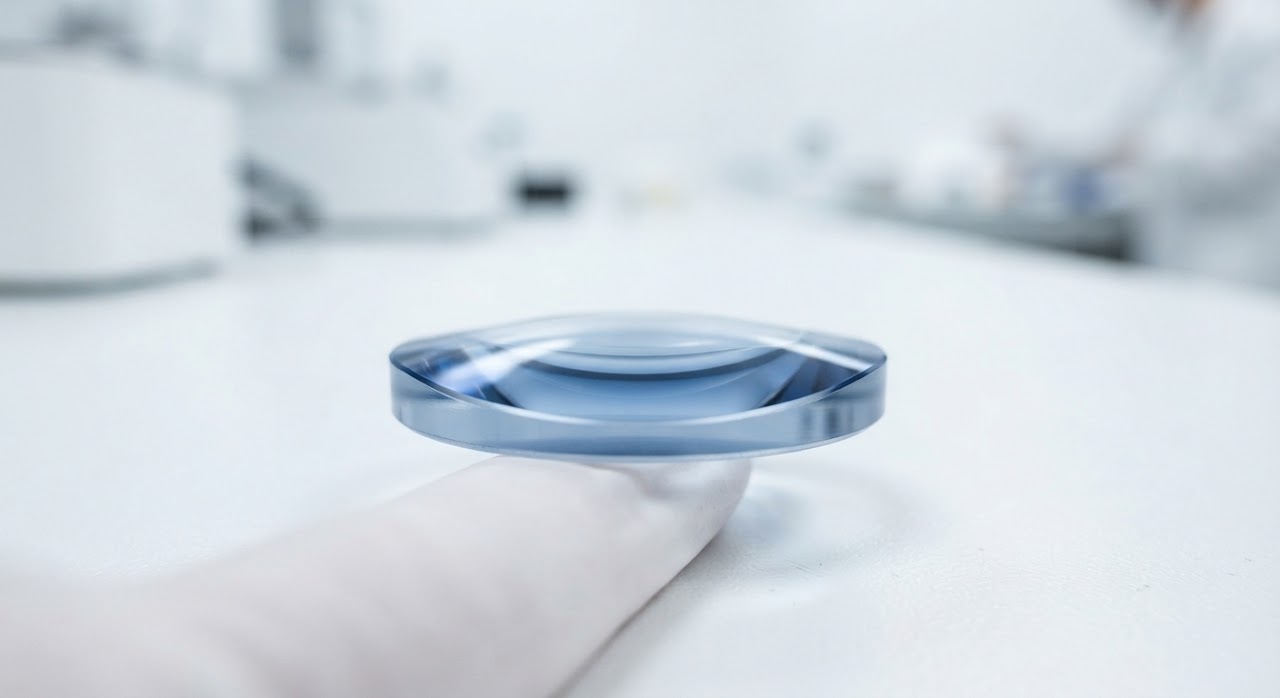
On a bench, the two glasses look almost identical. That is why engineers new to optics mix them up so often. The differences only reveal themselves once light travels through the material, and then they matter a great deal. Fused silica is our default when you need thermal stability and very high homogeneity. Borosilicate keeps costs down and handles teaching equipment, consumer devices and measurement setups that are not especially sensitive just fine. In practice, three things drive the decision: the wavelength band you work in, the thermal environment, and your budget.
Where these two glasses come from
Both belong to the silica glass family, so silicon dioxide forms the backbone of each. Think of ordinary window glass as a distant cousin and you will not be far off. The gap comes from how each one is refined and what it is refined for. Fused silica is close to pure SiO2 with almost nothing else added. Borosilicate carries B2O3 as a deliberate additive, and that is what gives it better resistance to thermal shock than standard soda-lime glass. Nearly every optical and thermo-mechanical difference we see later traces back to that compositional gap.
Comparing the criteria that matter
When we review material options with a new customer, we work through a short list of criteria. Thermal expansion and homogeneity usually decide the outcome, so we start there. Fused silica wins on both. Its coefficient of thermal expansion sits around 0.55 x 10^-6 /K, while borosilicate is closer to 3.3 x 10^-6 /K. Fused silica also transmits well deep into the UV and polishes to very low surface roughness. The trade is price, since it costs more. Borosilicate polishes respectably, but matching that surface quality takes more effort, and its UV transmission is more limited. The cost advantage is real, which explains why it stays popular wherever precision is not the top priority.
Why the CTE number changes your results
The coefficient of thermal expansion tells you how much a material grows as it warms. A value near 0.55 means fused silica barely changes shape when room temperature drifts. Borosilicate, at roughly six times that number, moves enough that you notice it in a lab where the air conditioning cycles on and off all day.
Once the optical surface deforms with temperature, wavefront error climbs and the image degrades. We once worked with a measurement rig that ran cleanly in the morning and slowly drifted by afternoon. After we swapped the window for fused silica, the drift nearly disappeared. The lesson stuck with us: the glass was the problem, not the software. Borosilicate is still perfectly usable when temperature swings are small and the instrument sits in a steady room. The goal is not to avoid it altogether. The goal is to avoid paying for fused silica properties your system will never use.
How homogeneity shapes image quality
Homogeneity describes how evenly the refractive index is spread through a block of glass. When it varies, light passing through different regions picks up different delays, and the result is added wavefront error. Fused silica usually contains fewer bubbles and striae, especially in large boules. That makes it the better pick for lenses that need low error.
For many high-accuracy designs, this factor counts for more than the price per piece. Borosilicate from small lots can be perfectly acceptable. If you plan to order in volume, though, we recommend inspecting a sample batch before committing to the full run. Teams that do this often avoid a painful rework later.
Wavelength range is often the deciding factor
If your system runs deep in the ultraviolet, the decision may already be made. Fused silica transmits well into the far UV. Borosilicate absorbs more strongly and can degrade under high-power UV lasers. We have seen borosilicate windows discolor and lose transmission after long exposure, an expensive surprise for a team that did not plan ahead.
For visible and near-infrared systems, borosilicate can still hold its own. A good first question is simply: what wavelength does my laser emit? That answer alone often narrows the choice to one material.
Polishing, surface finish and what to inspect
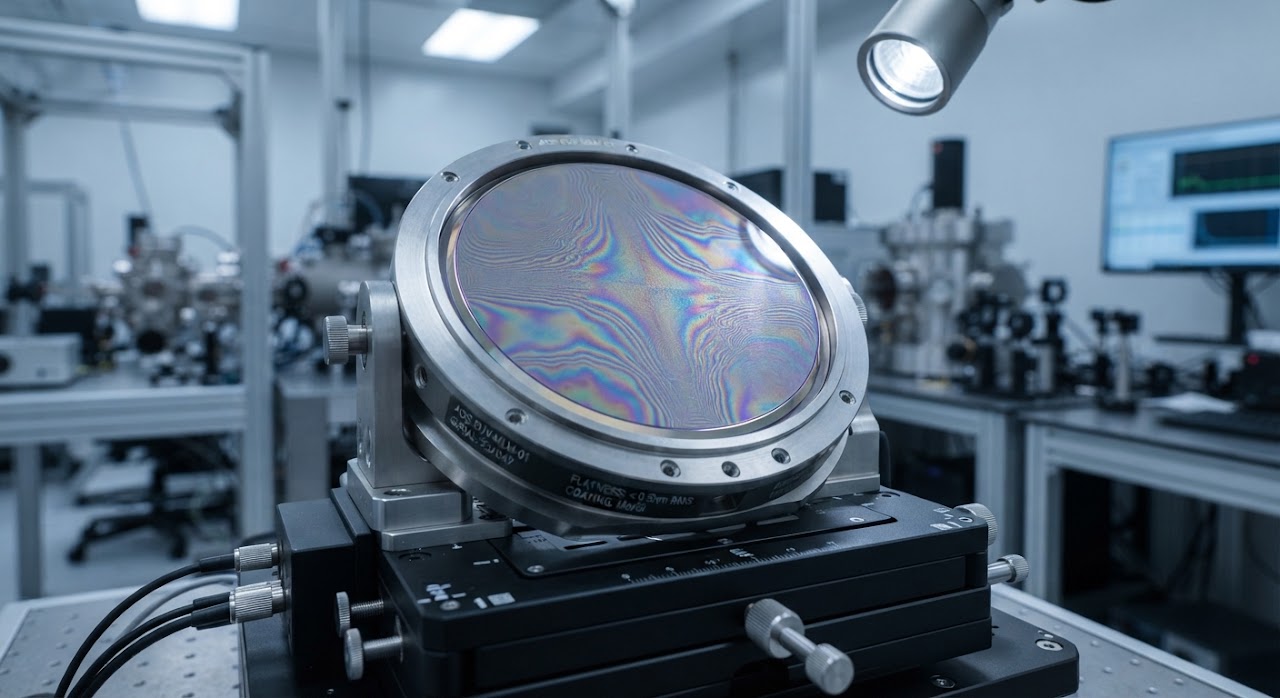
Fused silica lets you reach very low roughness and flatness, which is why it suits reference flats so well. Borosilicate polishes nicely, but it can leave tiny sub-surface defects at the nanometer scale. Those defects sometimes show up sharply when an interferometer tests the part, and they can slow acceptance down.
Fabrication and inspection should be planned around the material you chose. Running one polishing recipe on both glasses and expecting identical results is a common mistake. We would rather adjust the process up front than explain a rejected batch later.
Balancing cost against long-term performance
The price gap can be large, particularly for big apertures or small quantities. For educational instruments or consumer products, borosilicate can trim costs meaningfully while still meeting spec. For precision metrology, the extra spend on fused silica often pays back through better stability and less frequent recalibration. We usually ask clients to look at total cost over the life of the instrument, not just the number on the quote.
Which glass to specify for windows, flats and lenses
This is the section you will likely return to when writing a spec. For laser and UV windows, our recommendation is fused silica with very little debate. Reference flats and measurement mirrors also favor fused silica, since it holds flatness better over time. Lenses in less demanding equipment can often be made from borosilicate and still perform well. If coatings affect your transmission budget, our notes on multilayer mirror coatings for short wavelength optics explain how coatings get measured and checked in the shop.
When geometric error and material choice need a closer look
Geometric error in a lens determines how close you can get to the diffraction limit. A glass with poor homogeneity pushes that error higher, no matter how elegant the design looks on paper. We always suggest evaluating material and figuring process together. Surface error on curved parts is usually verified before assembly, and our overview of interferometric null testing aspheric optics shows how that verification is done.
Frequently asked questions
Is fused silica always better than borosilicate?
Not always, although it beats borosilicate on most optical criteria. If your application does not need high thermal stability or UV transmission, borosilicate may be the more sensible buy. What matters most is matching the glass to the real requirements of the system.
Can borosilicate handle UV lasers at all?
Low-power, short-duration UV work sometimes tolerates borosilicate. At higher power or continuous operation it absorbs more and degrades over time, so fused silica remains the safer option.
Why does a low CTE matter so much in precision optics?
As temperature changes, a low CTE helps the optical surface hold its shape. Without it, the surface shifts slightly, and the image shifts with it in ways that are hard to correct after assembly.
Can I switch to borosilicate to save money?
You can, but only after confirming that thermal error and homogeneity still fall inside your tolerance. Changing materials purely to cut cost, without re-measuring the system afterward, is a risk we would not take.
How do I know which material fits my design?
Start with three questions: what is your operating wavelength, how much does the thermal environment swing, and what wavefront tolerance can you accept? Once those answers are clear, the choice usually becomes obvious. If you are still unsure, ask your supplier to test a sample before ordering in quantity.