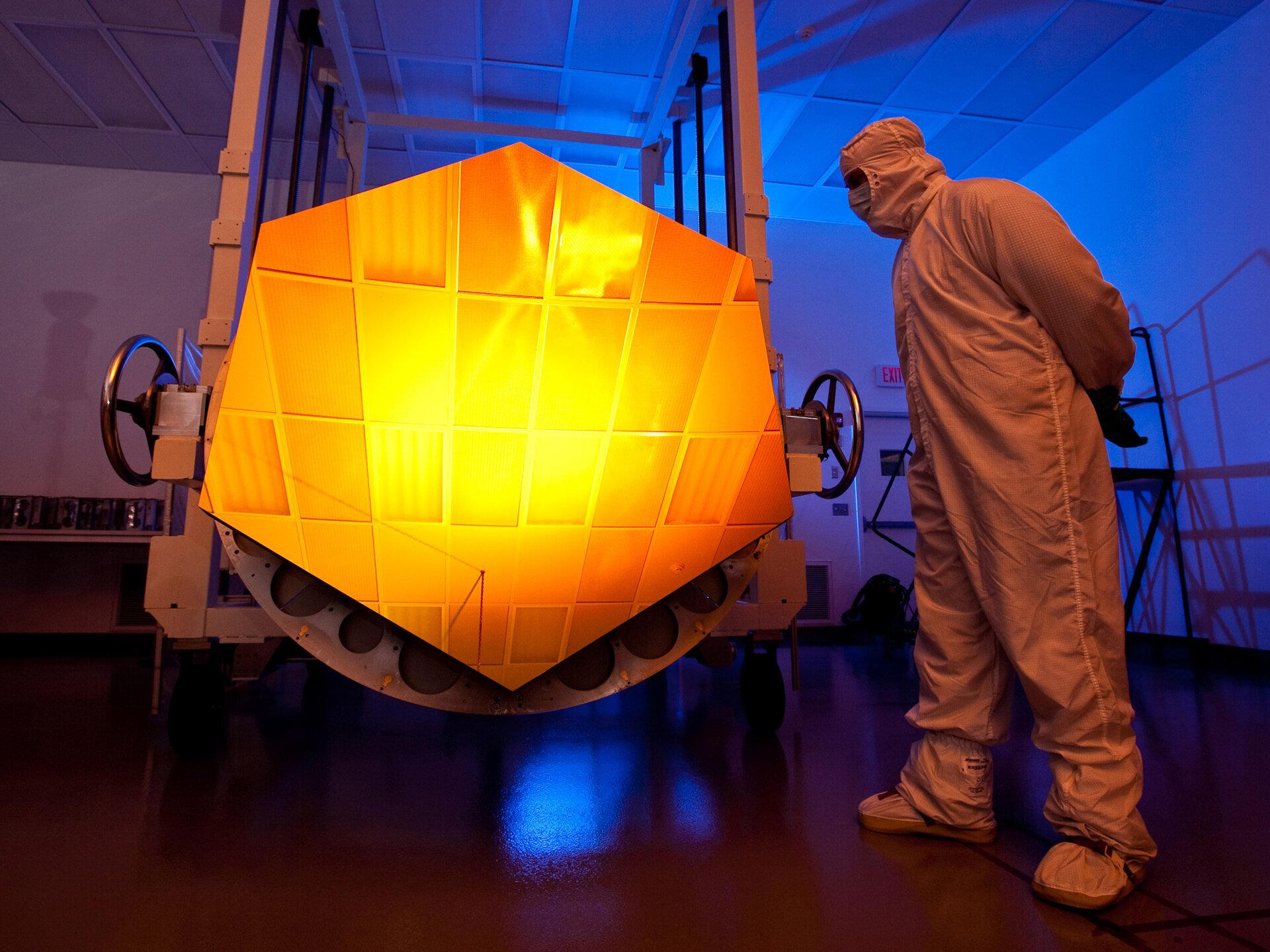
Lightweighted Mirrors for Satellites: Our Design Notes
Lightweighted mirrors for satellites: our team's hands-on notes on open-back, closed-back and honeycomb designs, plus material trade-offs for real missions.
10 min read
When our team starts a satellite telescope project, the primary mirror is almost always the heaviest optic on the board. Every gram there costs real money at launch, and that is why lightweighted mirrors for satellites are rarely optional for us. In practice we usually remove somewhere between 50 and 80 percent of the glass, keeping a thin face sheet on top and a grid of ribs underneath. The real debate is not whether to lighten. It is how to do it, and which material to use.
We have watched engineering groups argue for months over this choice. Most designs fall into three families: open-back, closed-back and honeycomb. Each one trades stiffness, thermal behavior and cost in its own way. Choose poorly and the mirror sags under its own weight during ground testing. Or it drifts out of shape as it cycles between hot and cold in orbit. We have seen both happen, and both are painful to fix late in a program.
Why every kilogram counts on a satellite
Launch pricing is counted in kilograms, and that is the first thing a client should understand. Mass added at the mirror rarely stays at the mirror. A heavier optic needs a heavier cell. It also needs stiffer mounts and a beefier backplane to hold it steady. We call this the hidden cost of mass. Newcomers usually miss it, so we raise it early in every discussion.
Mass also governs the first resonant frequency of the mirror, roughly how fast it wants to wobble. That frequency has to sit comfortably above the vibration spectrum the launch vehicle produces. If it does not, the mirror can crack or shift during ascent. Nobody wants to discover that after the rocket has left the pad, so we run these numbers long before any glass is cut.
Areal density, meaning mass per square meter of optical surface, is the figure we watch most closely. Lower areal density lets you build a larger aperture inside the same fairing volume, and a bigger mirror gathers more light. For many science missions, lightening is what makes the mission possible at all.
Open-back pockets: the straightforward route
An open-back design machines pockets into the rear of the blank and leaves them uncovered. Ribs support a thin front face. This is the easiest pattern to manufacture and inspect. Our team often recommends it for prototypes and for mirrors of moderate size, because the rear of the part stays visible throughout fabrication. Every machining step can be checked by eye and by probe.
The trade-off is stiffness. Without a rear plate, the structure flexes more readily. During ground testing we routinely see visible sag under gravity, and that sag has to be modeled and subtracted from the measured figure. Every correction adds a little uncertainty to the final result, so we keep the model honest and the margins visible to everyone on the team.
Closed-back: a rear plate for rigidity
A closed-back mirror bonds or fuses a rear plate over the pockets, turning the structure into a sealed box. The plate changes the character of the mirror entirely. At similar mass you get noticeably more stiffness and better thermal uniformity, since heat spreads more evenly through a closed structure. Thermal gradients are often the hidden enemy in orbit, so this advantage matters a great deal.
There is a price. Extra bonding or fusing steps introduce process risk. Cleaning or inspecting the inside of a sealed cavity is far harder than working on an open pocket. One of our earlier projects needed a second round of inspection because a trapped residue was only found after the plate was already in place. Plan for access early, or integration will remind you of it at the worst possible moment.
Honeycomb cores and print-through
Honeycomb cores, built from hexagonal or triangular cells, give the best stiffness for each kilogram. They are usually the route to the lowest areal density we can reach. The principle matches a honeycomb sandwich panel: a great deal of stiffness from very little material, arranged so that the faces carry bending and the core keeps them apart.
Cell size is a delicate call. Large cells save mass, but they can imprint their pattern onto the polished surface. That effect is called print-through. It shows up as a mid-spatial-frequency error that quietly erodes image quality, and it is easy to miss if you only look at a summary number. Core bonding quality matters just as much. We verify both with interferometry before accepting a mirror, because a clean-looking surface can still hide a faulty bond underneath.
ULE, Zerodur and silicon carbide
Material choice decides how far you can push lightening. ULE, a titanium-doped silica glass, has very low thermal expansion and shapes well. Its weakness is the lowest stiffness of the three, so it needs thicker faces and more support structure to compensate. For programs where thermal stability is the first priority, it remains a sensible starting point.
Zerodur is a glass-ceramic with excellent thermal stability and a long flight record on large mirrors. In stiffness it sits between ULE and silicon carbide. Many programs find it the comfortable, proven option. Its heritage is well documented, which tends to keep review boards relaxed. A strong flight history is often worth more to reviewers than a few kilograms saved.
Silicon carbide offers the best stiffness-to-density ratio, which permits the thinnest faces. It is expensive, though. Fabrication and polishing cycles run longer, and on a tight budget that alone can rule it out. We have had clients fall in love with the mass numbers and then lose the argument at the purchasing stage. We now raise that point before anyone starts comparing spreadsheets.
Balancing stiffness, print-through and cost
Stiffness rises with rib height and face thickness, but mass rises with them too. You are always trading one against the other. The useful question is rarely how light a mirror can be, but how light it can get while still meeting the error budget with margin to spare.
Thinning the face over large cells raises the risk of print-through, so the two parameters have to be chosen together. Cost climbs as you move from open-back to closed-back to honeycomb, and climbs again if you pick silicon carbide. A small mass saving can cost a surprising amount in fabrication time. We always ask the team what they are really buying before committing to a design.
Making and polishing lightweighted blanks
The sequence runs roughly like this. First we machine the core. Then we bond or fuse the plate or cells. Next we rough grind to set the dimensional baseline. Only after the core is fixed do we polish the face. The order matters, because any distortion left in the core will telegraph itself through the polished surface, and no amount of polishing fully erases it.
Before integration, subaperture metrology measures the finished surface in small overlapping patches. A single full-aperture test can smooth over local errors that matter a lot to the final image. This step is how we catch the defects that would otherwise surprise us later, and it is the part of the process we are least willing to shorten.
How we measure and qualify a lightweighted mirror
Surface figure is checked with interferometry. Stress and print-through need dedicated optical tests of their own, since they do not always show up in the basic figure measurement. Gravity sag and the support fixture can also mask the true figure, so we model them and subtract their effect from the data before drawing any conclusion.
Acceptance requires two conditions at once. The optical error budget and the structural frequency target must both be met. Passing one without the other is not a pass. We have had to tell teams that more than once. It is never a comfortable conversation, but it is far better to have it on the test bench than in orbit.
A worked example for a CubeSat-class payload
Imagine a university lab weighing options for a 300 mm mirror on a CubeSat-class payload. The figures below are illustrative. They show the shape of the trade-off rather than values to copy into your own budget.
The open-back design in ULE is the heaviest of the three, but it is the cheapest to build and the easiest to inspect. A closed-back mirror in Zerodur takes a middle path, with better thermal behavior and a proven record. The honeycomb option in silicon carbide is the lightest, but it carries a higher price and a longer schedule.
In a case like this, the honeycomb silicon carbide design saves the most mass but can roughly double the schedule. The heavier open-back design often turns out to be the one that makes the deadline. It feels less elegant on paper, yet it keeps the program moving. We have learned to let the calendar weigh as heavily as the kilograms, because a lighter mirror that arrives late delivers no science at all.
Where to start on your own mirror
Begin with the mission’s stiffness requirements, the thermal environment and the schedule. Then run early trade studies using finite-element and print-through models. Catching a problem on the computer is far cheaper than a redesign after the blank has been polished. It also gives the whole team a shared picture of where the margins really are.
For the wider system picture, it helps to read about segmented space mirrors alongside thermal testing. Our team’s notes on on-orbit wavefront sensing for segmented mirrors show how these pieces behave together once a telescope is flying. Clear technical writing matters as much in the documentation as in the hardware. Some teams lean on a specialist thiết kế web partner to present complex material to their readers in a way that is easy to follow.
Frequently asked questions
How much mass can a satellite mirror lose through lightweighting?
Typically 50 to 80 percent of the glass can be removed. The exact figure depends on the design pattern and the material chosen. Pushing beyond that range usually costs stiffness you cannot easily recover without adding mass back somewhere else.
Is honeycomb always better than open-back for space optics?
No. Honeycomb is stiffer per kilogram, but it brings print-through risk and higher cost. For a smaller or simpler mirror, open-back is frequently the sensible choice, and we have delivered plenty of successful missions with it.
Which material is best for a low-cost satellite mirror?
ULE is usually the most economical to shape, though it is the least stiff of the three. Zerodur offers a strong middle ground with a good flight record, and it is worth considering before you commit to silicon carbide.
Does lightweighting affect the image quality of the telescope?
It can, if print-through or core distortion goes uncontrolled. That is exactly why we rely on interferometry and subaperture metrology to verify the surface before acceptance, rather than trusting a single summary figure.
Where can I learn more about on-orbit wavefront sensing and thermal-vacuum testing?
Start with our write-up on on-orbit wavefront sensing. Then look into thermal-vacuum testing of space telescope optics to prove performance before launch.